Best Sunset Spots in Muscat: 10 Places for Beaches, Mountains & Golden Hour Views
Quick Answer
The best sunset spots in Muscat depend on the experience you want. Shatti Al Qurum is the easiest all-round choice, Muttrah Fort offers the most iconic historic view, Muscat View Point is best for photography, and Bandar Khairan delivers the most unique boat-based sunset experience.
| Spot | Type of View | Access | Crowd Level | Best For |
|---|---|---|---|---|
| Shatti Al Qurum Beach | Open sea, beach-level | Walk-up, free | High, especially weekends | Easy, walkable sunset with dining nearby |
| Muttrah Fort | Harbor and corniche from above | Walk-up, seasonal hours | Moderate to high | History and harbor view together |
| Azaiba Beach | Open sea, beach-level | Walk-up, free | Low to moderate | Quieter, local-feel sunset |
| Ras Alhamra | Rocky shoreline and golf course | Public by day, restricted evening access | Low | Tidy, early golden-hour sunset |
| Airport Heights | Hills and suburbs, no sea | Trail, some walking required | Low to moderate | Hikers wanting a city-and-hills view |
| Qantab Hills | Fishing bay from a hillock | Short climb from the beach | Low to moderate | Compact bay-and-village view |
| Bowshar Heights | City skyline, no sea | Drive-up, roadside | Low | Quick car-based skyline stop |
| Muscat View Point | Mountains, sea, and skyline combined | Short drive plus short walk | Low to moderate | One clean panoramic photo frame |
| Bandar Khairan | Lagoon and cliffs, sea-level | Boat or kayak required | Low, booking-dependent | Unique boat-based sunset |
| Yiti Beach | Open sea, cliff-framed cove | Long drive or boat from Qantab | Low on weekdays, busy Fri/weekends | Remote, cliff-framed sunset |
Introduction
Muscat doesn’t do sunset the way a lot of coastal cities do. There’s no single boardwalk everyone funnels toward at 6 PM. The city is squeezed between the Hajar Mountains and the Gulf of Oman, so the sun disappears differently depending on where you’re standing: straight into the sea from the northern beaches, behind jagged hills from the eastern coves, or behind rooftops and forts from the hilltop lookouts around town. That geography is what makes this list worth having. Two people can both say they watched “the Muscat sunset” and mean completely different evenings.
Locals tend to sort themselves by habit more than by hype. Qurum crowd is a coffee-and-promenade crowd. Qantab and Bandar Khairan pull in the boat-and-hike types. Bawshar and the airport-side hills get the drivers who want a skyline shot without leaving the car for long. None of these are objectively “the best,” they just answer different evenings, and the list below is built around that.
Decision Factors
Nine spots, one sunset window, so it helps to know what actually separates them before picking one:
- Accessibility: some spots are a flat walk from a parking lot (Shatti Al Qurum, Azaiba), some need a short climb (Qantab Hills, Airport Heights), and one needs a boat or kayak (Bandar Khairan).
- Timing: gates, evening access rules, and daylight all matter here. Ras Alhamra’s public beach in particular has a cutoff after which access narrows, so “sunset” there means arriving early, not late.
- Comfort level: beach promenades have cafes and shade nearby; hilltop and fort viewpoints generally don’t, so factor in water and footwear.
- Crowd patterns: Shatti Al Qurum and Muttrah Corniche get busy on Thursday and Friday evenings; Azaiba, Qantab Hills, and the inland viewpoints stay noticeably quieter.
- Indoor/outdoor suitability: everything on this list is outdoors, but some (Shatti Al Qurum, Muttrah Fort) sit next to restaurants and cafes if the plan is to stay past sunset, while others (Bowshar Heights, Muscat View Point, Bandar Khairan) are look-and-go stops with no amenities on site.
Sunset Time in Muscat
Sunset in Muscat shifts by close to an hour and a half across the year, so “sunset” means something different in January than it does in July. Through the winter months, roughly November to February, the sun drops around 5:15 to 5:30 in the evening, while during the peak of summer, from May through August, it holds on until closer to 6:45 or 7:00 PM. The shoulder months in between slide gradually between those two extremes.
What extends the window a bit further is civil twilight, the stretch right after the sun disappears when there’s still enough natural light to shoot or walk comfortably. In Muscat that adds roughly another 25 to 30 minutes on top of the actual sunset time, which is part of why beach promenades and hilltop viewpoints alike tend to stay busy well past the moment the sun technically sets.
Because the exact time moves through the year, it’s worth checking a sunset calculator for the specific date of your visit rather than relying on a fixed clock time, especially for spots on this list that require some travel time to reach, like Bandar Khairan or Yiti Beach.
Shatti Al Qurum Beach
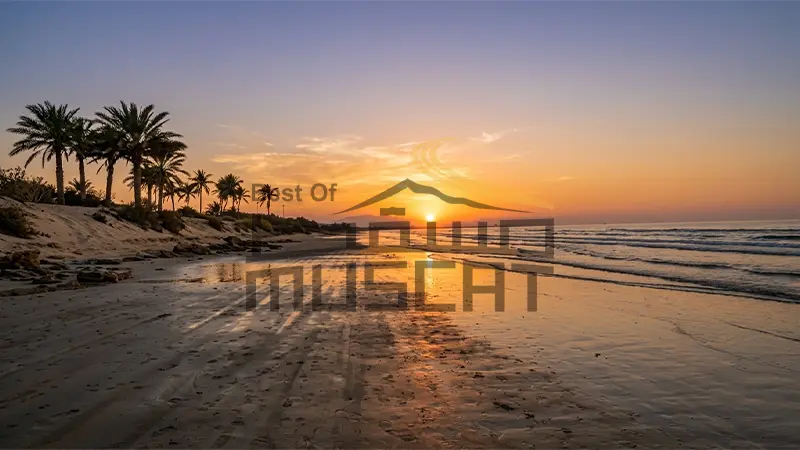
Muscat’s most reliable sunset, right off the promenade, with a coffee shop never more than a five-minute walk away.
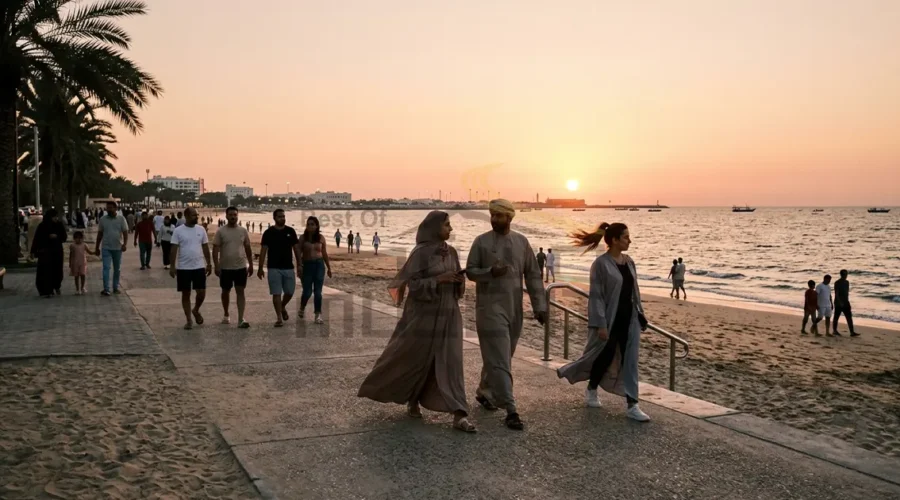
This is the default answer for a reason. The beach runs for a long, clean stretch along the coastal road, backed by cafes, restaurants, and an open-air walking track, and in the evening the whole strip turns into a slow procession of joggers, families, and couples timing their walk to the horizon. Because the beach faces open sea, you get an unobstructed view for miles along the coast, which is part of why photographers keep coming back to it.
It’s also the most social sunset on this list. Expect beach volleyball wrapping up, fishermen hauling nets if the tide is right, and a genuinely lively, unhurried atmosphere rather than a quiet one. If you’d rather compare it against the rest of the city’s coastline first, our guide to Muscat’s best beaches breaks down how Shatti Al Qurum stacks up against Azaiba, Ghubrah, and the others.
The trade-off is exactly what you’d expect from the most popular spot on the list: parking gets tight in the final half hour before sunset, especially on weekends, so arrive earlier than you think you need to.
Best for: an easy, walkable sunset with dinner already lined up nearby.
Muttrah Fort
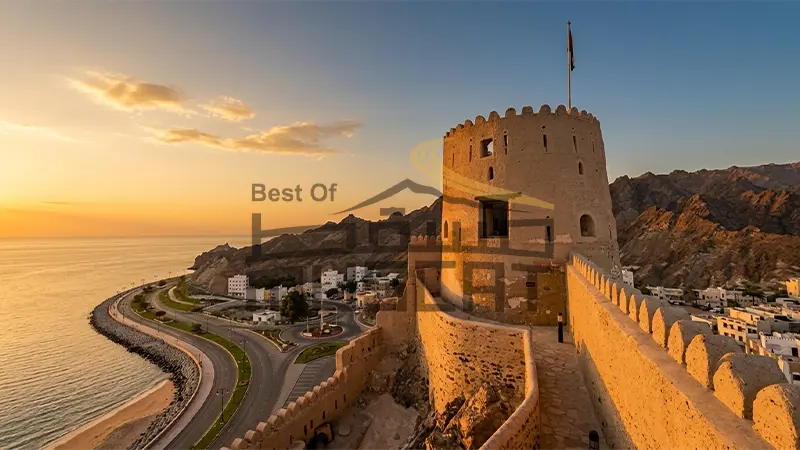
A 16th-century fort on the hill above Muttrah harbor, watching the dhows and the corniche turn gold below it.
Muttrah Fort sits on high ground overlooking Muscat’s old natural harbor, and its watchtowers were originally built to do exactly what tourists now use them for: keep an eye on the whole bay. From the ramparts you get a sweeping view of Muttrah Corniche, the harbor traffic, the souq rooftops, and the mountains framing the far side of the bay, all of it catching the same warm light at once.
The fort itself is compact, a handful of old cannons and a walk along the walls rather than a museum with rooms to wander through, so it pairs naturally with a walk along the corniche or a stop at the souq either before or after. According to the fort’s official heritage site, which operates under Oman’s Ministry of Heritage and Tourism, the structure dates to around 1507 AD and was later reinforced by the Portuguese during their occupation of the coast, which is part of what gives the view its layered, old-harbor character. If you want to turn the visit into a full evening, Muttrah’s restaurant scene has several spots along the corniche built around exactly this sea view.
Because it’s a small historic site rather than a park, there’s nowhere to sit and linger. Opening hours can also shift seasonally, so it’s worth confirming before you plan the visit around last light.
If Muttrah Fort is the only stop on your list so far, it’s worth knowing there’s a lot more to the neighborhood around it. Our full guide to the best things to do in Muttrah covers the souq, the fish market, and the Corniche walk that ties everything together, so the fort can anchor a full afternoon rather than a quick sunset stop.
Best for: pairing history with a harbor view, especially if a corniche walk is already part of the evening.
Azaiba Beach
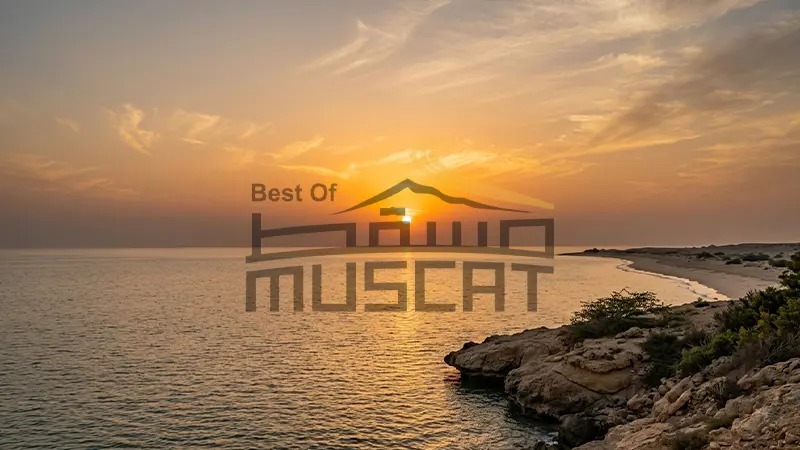
A quieter, more local stretch of sand between Ghubrah and Qurum, with fishing huts standing in for the promenade cafes.
Azaiba is what Shatti Al Qurum looked like before it got polished. The beach is long and mostly undeveloped, with a jogging path, a small pier used for fishing, and a scattering of handmade fishing huts that give it a distinctly local character rather than a touristy one. Jet skiing and horseback riding show up here too, and the crowd skews toward Muscat residents rather than visitors.
Because the beach is wide and open with very little built up around it, the sunset itself reads a bit rawer than at Qurum, less framed by cafe lights, more just sky and sand. It’s an easy add-on to a wider coastal evening as well; the same corridor covered in our Qurum to Quriyat coastal drive guide starts right around here.
The trade-off is comfort. Some stretches are rocky rather than sandy, mosquitoes can show up once the sun drops, and there’s minimal lighting after dark, so plan to head out shortly after the sky fades rather than lingering.
Best for: a calmer, more residential sunset without the Qurum crowd.
Ras Alhamra
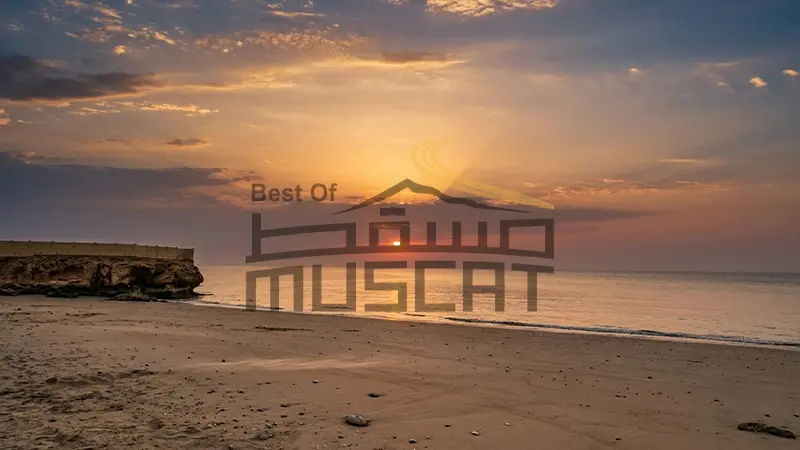
A tidy, rocky-shored beach tucked next to the PDO complex and golf course, best caught early rather than right at dusk.
Ras Alhamra, often associated locally with the PDO area and Marjan Beach, sits alongside the members-only PDO recreation club and its golf course, and the public section of the shoreline has a noticeably calmer, more organized feel than most city beaches. The rocky seabed makes it more of a snorkeling and photography spot by day, and in the evening the water and golf course greens both pick up the same warm light.
The one detail that matters most for sunset planning here: public access to this stretch typically narrows in the evening, with the area reserved for PDO staff and authorized visitors after that point. That makes this a golden-hour spot rather than a lingering, after-dark one, so the plan is to arrive with time to spare, not to chase the very last light.
Best for: a quieter, cleaner sunset for anyone timing their visit to arrive before the evening access window closes.
Airport Heights
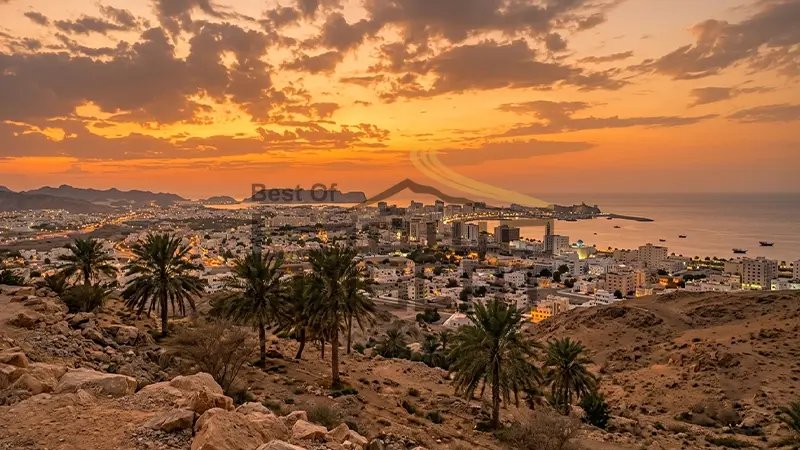
A hillside trail near Muscat International Airport that trades sea view for a wide-open panorama of the surrounding hills and suburbs.
This one breaks the pattern of the list, since the payoff isn’t the sea, it’s elevation. Airport Heights has a marked hiking trail that climbs into the hills bordering the airport district, along with a park and BBQ area partway up, and the higher points give a genuinely panoramic view over the city’s northern suburbs and the hills beyond them. It’s a popular after-work hike for people who want movement built into their sunset rather than a spot to just sit and watch.
Because it’s a proper trail rather than a paved viewpoint, it rewards showing up with decent shoes and enough daylight left to get back down comfortably.
There’s no shade and no facilities along most of the route, so this isn’t the spot for a spontaneous, last-minute stop; it works best when the hike itself is part of the plan.
Best for: hikers who want a city-and-hills sunset instead of a coastal one.
Qantab Hills
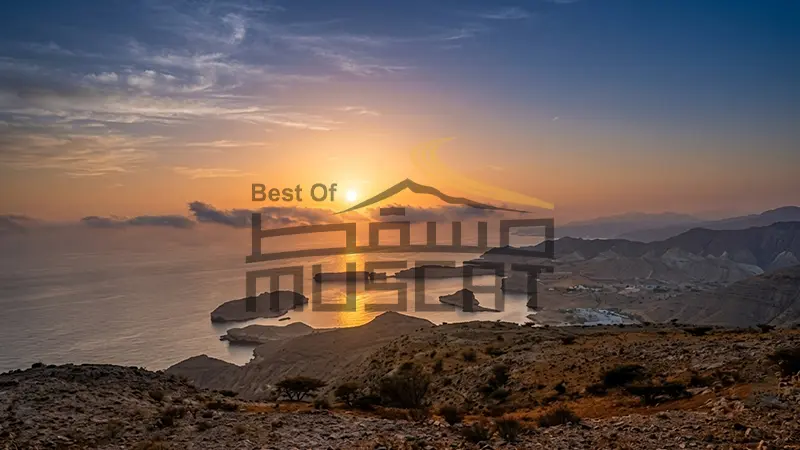
A short climb above Qantab’s fishing village, ending at a hilltop car park with the whole bay laid out below.
Above Qantab Beach, a small hillock rises over the village and the water, reachable either by a short walk up from the beach or by parking directly at the hillside car park partway up the road. From the top, the view takes in the fishing boats pulled up on the sand, the curve of the bay, and the mountains that box the village in on either side, all lit up as the sun drops toward the water.
It’s a genuinely different flavor of sunset from the open-coast beaches: smaller-scale, more intimate, framed by rock rather than open horizon. Locals treat the climb as a quick, five-minute detour rather than a full hike, which is part of its appeal.
The path up is rocky rather than paved in places, and the small hillside car park fills up quickly once people start arriving for the evening light, so getting there with some buffer time helps.
Best for: a short, scenic climb that pairs a fishing-village view with the sunset.
Bowshar Heights
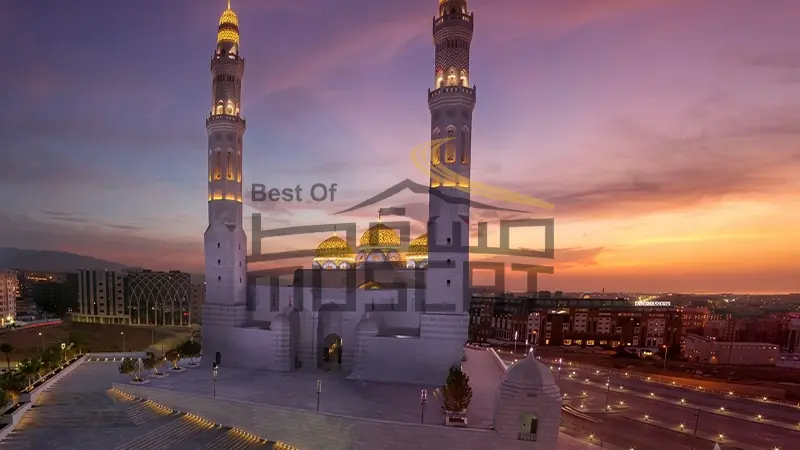
A winding hill drive above the city that trades the coast for a wide, elevated view of Muscat’s skyline as the light fades behind the mountains.
Bowshar’s elevated areas, reached along roads like Al Amerat Road as they climb up from the city, are known among locals as one of the better car-based spots for a skyline view rather than a sea view. As the road twists upward, the city opens up below in a way that’s genuinely photogenic, closer to a lookout point than a beach.
This is a stop-the-car-and-look spot rather than a destination with parking and paths, which is exactly the appeal for people who don’t want to commit a full evening to a single viewpoint.
Because it’s a hill road rather than a maintained park, it isn’t the easiest place to navigate once it’s fully dark, and the exact view varies depending on where along the road you stop, so it rewards a bit of scouting on a first visit.
Best for: a quick, car-based skyline sunset on the way somewhere else.
Muscat View Point
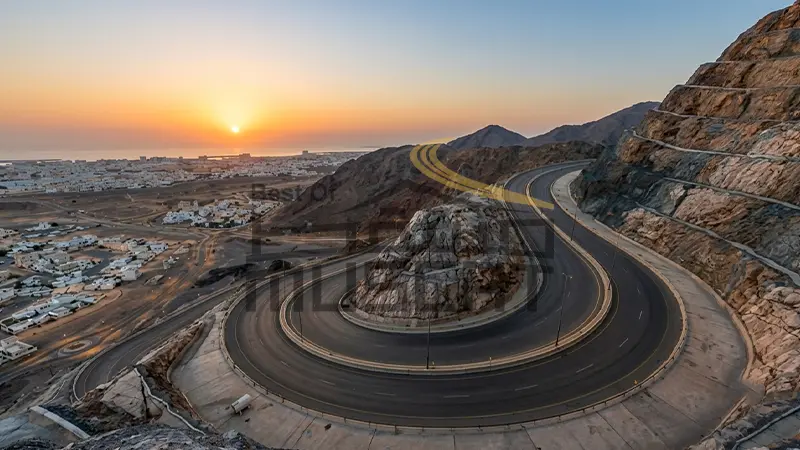
A signposted lookout above the coastal road that lines up mountains, sea, and city skyline in a single frame.
Muscat View Point sits on a hill just off the coastal road toward Al Jissah, reached by a short drive followed by a brief walk up to the viewing area. What sets it apart from the beach-level spots is the composition: from up here you get the contrast between the rugged mountains, the sea, and the city’s rooftops all at once, which is why it shows up so often in photography recommendations for the area.
The walk up is short enough for most visitors, but it’s still a walk, not a drive-right-up spot, so comfortable shoes make the visit easier.
There’s nothing on site beyond the view itself: no cafe, no shade, no seating, so this works best as a look-and-go stop rather than somewhere to spend the whole evening.
Best for: photographers who want one clean panoramic frame of mountains, sea, and skyline together.
Yiti Beach
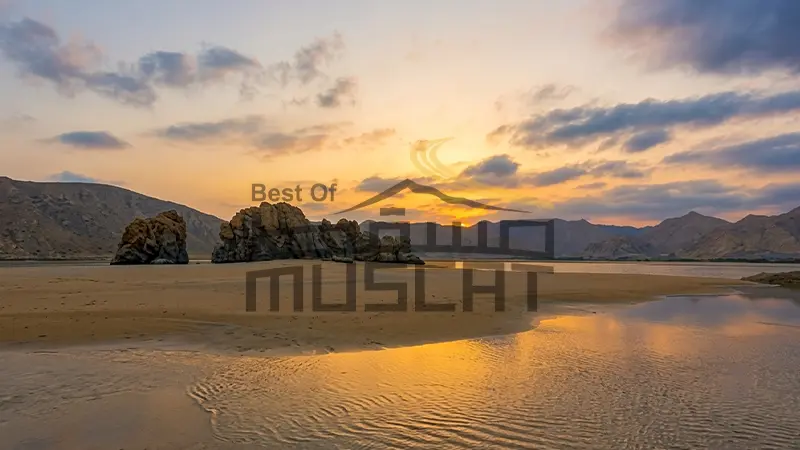
A secluded cove 28km southeast of the city, reached by a winding mountain road that’s arguably better than the beach itself.
Yiti sits past Qantab and Bandar Jissah, boxed in by cliffs and coves that keep it feeling far more remote than the drive time suggests. The sand runs darker and coarser than Qurum or Azaiba, but the payoff is the color shift at sunset: the sand takes on an orange cast and the water deepens to a richer blue as the light drops, with several visitors climbing onto the rocks above the beach for a twilight view rather than watching from the sand itself. Oman’s Ministry of Tourism has described this same stretch as a small, roughly kilometer-long beach popular for barbecues, camping, and fishing, which lines up with how locals actually use it.
The village and the fishing boats nearby add some life to the visit, and it’s also possible to reach Yiti by hiring a small boat from Qantab village instead of driving, which turns the trip itself into part of the evening.
The drive in is the real limitation here: it’s a long, winding mountain road with no fuel stations and almost no shops along the way, so arrive with a full tank and your own water and snacks. Weekends and Fridays also bring a livelier, sometimes music-and-drinks camping crowd, so this isn’t the quiet option on those specific evenings.
Best for: a remote, cliff-framed sunset for anyone willing to make the drive.
Bandar Khairan
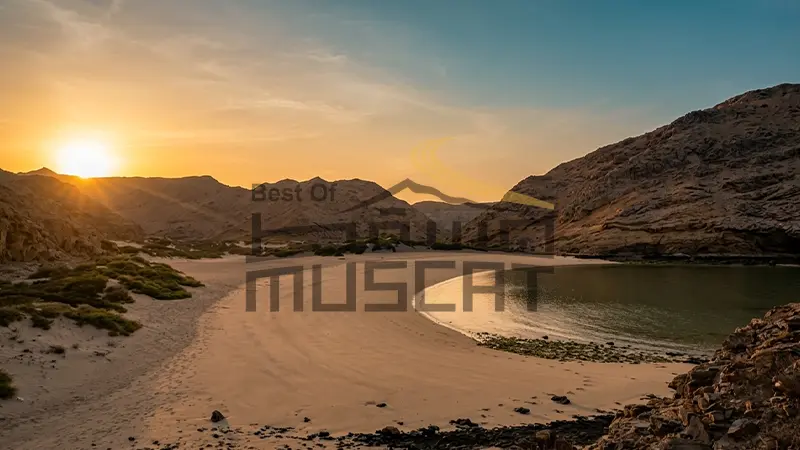
A mangrove-fringed lagoon southeast of the city where the sunset has to be reached by water, not by road.
Bandar Khairan is a natural harbor carved into the coastline south of Muscat, and most of it is genuinely inaccessible on foot; the usual way in is by boat or kayak from Bandar Jissah or Bandar Al Rowdha marina. What you get in exchange is a sunset unlike anything else on this list: sandstone cliffs and their reflection in the water shifting color as the light drops, with almost none of the noise or infrastructure of the city-side spots. It’s become a well-known destination for sunset kayaking tours specifically because of this.
For a wider sense of how this fits into a longer coastal day out, it sits at the far end of the same stretch covered in our Qurum to Quriyat coastal road trip, past Qantab and Yiti.
The obvious limitation is access. This isn’t a spot you can decide to visit on a whim thirty minutes before sunset; it needs a booked kayak or boat trip, or a longer drive via the Yiti–Jebel Seifa road for the sections reachable by land. However, Bandar Khairan is not recommended for first-time visitors driving alone after sunset, because the roads can be confusing
Best for: a one-of-a-kind, boat-based sunset for anyone planning ahead.
How to Get to Each Sunset Spot
Shatti Al Qurum Beach: on the main coastal road, ample parking, easy by taxi.
Muttrah Fort: walkable from Muttrah Corniche parking, right next to the souq.
Azaiba Beach: coastal road between Ghubrah and Qurum, straightforward by car or taxi.
Ras Alhamra: off the road running past the PDO complex, best reached before evening access narrows.
Airport Heights: trailhead near the airport district, a car is the easiest way in.
Qantab Hills: via Qantab Road, short climb from the village car park.
Bowshar Heights: reached along Al Amerat Road as it climbs into the hills.
Muscat View Point: short drive off the coastal road toward Al Jissah, then a brief walk up.
Bandar Khairan: by boat from Bandar Jissah or Bandar Al Rowdha marina, or partly by road via the Yiti–Jebel Seifa route.
Yiti Beach: a winding road from the Hamriyah area, or a short boat ride from Qantab village. Fill up on fuel beforehand, there are no stations along the way.
Local Insight: Timing It Right in Oman
Sunset-watching in Muscat has a season. From October through April, evening temperatures drop enough to make sitting outside genuinely comfortable, and this is when Shatti Al Qurum, Azaiba, and the hilltop spots see their heaviest evening traffic, especially on Thursday and Friday. Through the hotter months from May to September, the beaches and viewpoints are still active at sunset since the worst of the heat has broken by then, but daytime visits to the same spots are far less pleasant.
Weekend patterns are worth knowing too: Friday and Saturday evenings bring noticeably bigger crowds to Shatti Al Qurum and Muttrah Corniche, while Azaiba, Qantab Hills, and the inland viewpoints stay quieter even on weekends. During Ramadan, sunset takes on a different rhythm across the city, since it lines up with iftar; beaches and open viewpoints tend to fill up right around maghrib as families gather outdoors to break the fast, so expect a livelier, more communal atmosphere at that hour specifically.
Photography Tips
The nine or ten spots on this list reward different camera habits. Beach-level shots at Shatti Al Qurum or Azaiba benefit from getting low, close to the waterline, so the wet sand picks up the reflected color of the sky. Elevated spots like Muscat View Point, Bowshar Heights, or Qantab Hills work the opposite way: the higher vantage point is the whole point, so a wider frame that includes some foreground rock or trail tends to read better than a tight shot of the horizon alone.
Timing matters as much as location. The 20 to 30 minutes before the sun actually touches the horizon, often called golden hour, gives the warmest, most even light, while the few minutes right after sunset, blue hour, is when the sky itself often produces the more dramatic color, especially from harbor viewpoints like Muttrah Fort where the fort walls and the water both catch it. It’s worth staying a little past sunset rather than packing up the moment the sun disappears.
A few practical notes specific to this list: Muttrah Fort and Ras Alhamra both have access windows to keep in mind, so arrive with enough buffer to shoot before things wind down. Bandar Khairan and Yiti Beach, being boat or drive-in spots, are worth scouting once in daylight if possible, since working out your composition on the day itself, with a boat or a long drive already behind you, leaves less room to adjust.
Sunset Safety & Etiquette Tips
A few of these spots ask a little more of visitors than a flat beach walk, so it’s worth planning around that rather than finding out on arrival. The rocky shorelines at Ras Alhamra and Yiti Beach are easier with proper footwear than sandals, and the hillside trails at Airport Heights and Qantab Hills are best timed to finish the climb before it’s fully dark, since neither has lighting.
Driving deserves its own note. The winding hill roads up to Bowshar Heights and out to Yiti Beach are scenic but narrow in places, with other visitors sometimes pulled over for photos, so a slower pace pays off. For Bandar Khairan, book with an operator who provides life jackets and checks sea conditions before heading out, rather than arranging a boat informally.
On the etiquette side, modest swimwear is the norm on Muscat’s public beaches, and public alcohol consumption generally isn’t part of the scene outside licensed venues, so it’s worth keeping that in mind if a sunset outing turns into an evening picnic.
Match Your Mood to the View
Fast vs. slow: if the plan is a quick stop on the way somewhere else, Bowshar Heights or Muscat View Point are built for that; a five-minute pull-over gets you the whole payoff. If the evening is the plan, Shatti Al Qurum, Azaiba, or Muttrah Fort give you somewhere to stay once the sun’s down.
Casual vs. planned: Shatti Al Qurum, Azaiba, and Ras Alhamra all work as spontaneous, show-up-and-watch evenings. Bandar Khairan is the opposite; it needs a booked boat or kayak, so it’s the one spot on this list worth planning a few days ahead for.
Coastal vs. elevated: for a horizon-into-the-sea sunset, stick to Shatti Al Qurum, Azaiba, or Ras Alhamra. For a city-and-mountains composition instead, Airport Heights, Qantab Hills, Bowshar Heights, and Muscat View Point all trade the sea for elevation.
Frequently Asked Questions (FAQ)
What is the single best sunset spot in Muscat for a first-time visitor?
Shatti Al Qurum is the easiest starting point. It’s central, walkable, backed by cafes and restaurants, and gives an unobstructed sea view without any hiking or boat booking required.
Is Muttrah Fort or Muscat View Point better for photography?
They suit different shots. Muttrah Fort frames the sunset with the harbor, dhows, and souq rooftops for a historic, layered composition, while Muscat View Point gives a cleaner, wide panorama of mountains, sea, and skyline together.
How much does it cost to watch sunset at these spots?
Cost varies. Shatti Al Qurum, Azaiba, Airport Heights, Qantab Hills, Bowshar Heights, and Muscat View Point are all free to visit. Bandar Khairan is the exception, since reaching it usually means booking a kayak or boat tour.
Is Ras Alhamra open to the public at sunset?
The public section is accessible during the day and into early evening, but access is typically restricted to PDO staff and authorized visitors after that point, so it’s best treated as a golden-hour spot rather than an after-dark one.
Do I need a car to reach these spots?
Most of them, yes. Shatti Al Qurum and Muttrah Fort are reachable by taxi easily enough, but Airport Heights, Qantab Hills, Bowshar Heights, and Muscat View Point are far more convenient with a car, and Bandar Khairan needs a boat regardless of how you get to the marina.
What’s the best season for watching sunsets in Muscat?
October through April is the most comfortable window, with cooler evenings that make sitting outside at any of these spots genuinely pleasant. Sunsets happen year-round, but the comfort level around them changes with the season.
Which spot works best during Ramadan?
Open beach and viewpoint spots like Shatti Al Qurum and Azaiba tend to get busy right at maghrib as families gather for iftar, which gives them a livelier, more communal feel during Ramadan specifically.
Can Bandar Khairan be reached without a boat?
Partially. Some sections are reachable by road via the Yiti–Jebel Seifa route, but the classic lagoon view most people associate with Bandar Khairan is a boat or kayak trip from Bandar Jissah or Bandar Al Rowdha marina.
Which spot is most family-friendly for a sunset outing?
Shatti Al Qurum and Azaiba are the most straightforward for families, with flat, easy access, nearby facilities, and space for kids to move around while the adults watch the sky.
Qantab Hills or Bowshar Heights, which one for which view?
Qantab Hills gives a smaller, more intimate bay-and-fishing-village view after a short climb. Bowshar Heights trades that for a wider, car-accessible skyline view of the city itself.
Yiti Beach or Bandar Khairan, which for a remote sunset?
Yiti is reachable by road (though a long, winding one) and works for a car-based sunset; Bandar Khairan needs a boat or kayak specifically. Also consider folding a fuel/facilities note into the existing “do I need a car” answer.
What is the most romantic sunset spot for couples in Muscat?
Bandar Khairan offers the most memorable romantic sunset experience with its cliffs, calm waters, and boat-based access. For an easier option, Shatti Al Qurum and Qantab Hills are also great choices.
What time does the sun set in Muscat?
Sunset time in Muscat changes throughout the year. It is usually around 5:15-5:30 PM in winter (November to February) and closer to 6:45-7:00 PM in summer (May to August). For the best golden-hour views, arrive 30-45 minutes before sunset, especially for spots that require extra travel time like Bandar Khairan or Yiti Beach.
Where can I watch sunset in Muscat for free?
Most sunset spots in Muscat are free, including Shatti Al Qurum Beach, Azaiba Beach, Qantab Hills, Bowshar Heights, Airport Heights, and Muscat View Point. Bandar Khairan usually requires a paid boat or kayak trip.
How early should I arrive before sunset in Muscat?
Arrive 30-45 minutes before sunset to enjoy the golden-hour light and find parking. For popular locations like Shatti Al Qurum and Muttrah Fort, arriving earlier is recommended on weekends.
Is Muscat good for sunset views?
Yes. Muscat’s unique geography, where the Hajar Mountains meet the Gulf of Oman, creates a variety of sunset experiences from beaches and harbors to hilltop viewpoints and hidden coastal areas.